Take Heart Counseling & Equine Assisted Therapy
Take Heart Counseling & Equine Assisted Therapy
By Meagan Good, MA, LPC, NPT-C, NLC-P, EP
Founder & Counselor, Take Heart Counseling & Equine Assisted Therapy — Wernersville, PA
If you have ever wondered why you can understand exactly what happened to you — talk about it, explain it, even make peace with it in your mind — and yet still feel it in your chest, your shoulders, your stomach, or the way you startle at a slammed door, you are not imagining things. And you are not broken. Your body is doing something it was designed to do.
Trauma is not only a story the mind remembers. It is a pattern the body holds. Understanding that difference changes everything about how healing actually works — and it is the reason so many people find relief in approaches that involve the body, not just the mind.
Trauma stays in the body because it lives in the nervous system, not just in memory. During a threat, the body activates survival responses — fight, flight, or freeze — driven by the autonomic nervous system. When that alarm never fully resets, the body can keep bracing for danger long after the event has passed.
When something overwhelming happens, your brain and body respond faster than conscious thought. Your autonomic nervous system — the automatic control system that runs your heart rate, breathing, and muscle tension — shifts into survival mode. Stress hormones like adrenaline and cortisol flood your system, your heart races, your muscles tense, and the thinking, reasoning part of your brain quiets down so the survival part can take over.
This is a good design. It is what helps a person run from danger or brace for impact. The difficulty comes afterward. Sometimes the nervous system never receives the signal that the danger has passed, so it keeps running the same protective program — tension, hypervigilance, a racing heart — in ordinary moments that are not actually threatening. The body is still trying to keep you safe from something that is already over.
Psychiatrist Bessel van der Kolk gave this experience its most well-known name in his 2014 book The Body Keeps the Score, popularizing the idea that trauma leaves an imprint on the body and not just the mind. His framing has been enormously influential, and — like any single framework — it has also been debated in the research community. What remains well established, and far less contested, is the underlying physiology: trauma dysregulates the nervous system, and that dysregulation is felt in the body.
Trauma held in the body often shows up as physical sensation rather than clear memory: chronic muscle tension, a racing or pounding heart, shallow breathing, digestive issues, exhaustion, feeling constantly on edge, or feeling numb and shut down. These are nervous-system states, not character flaws or personal weakness.
People are often surprised by how physical trauma feels. It is not always flashbacks or vivid memories. More often it is the body speaking in its own language:
A constant, low hum of tension you can never quite put down — shoulders up, jaw tight, stomach clenched.
A heart that races or pounds for no reason you can point to. Sleep that will not come, or will not stay. A quickness to startle. Digestive trouble that no diet seems to fix. Or, on the other end, a heavy numbness — feeling flat, foggy, disconnected, or exhausted in a way rest does not touch.
These are not signs of weakness, and they are not something to be ashamed of. They are the marks of a nervous system that has been working overtime to protect you. When we understand them as physiology rather than personal failure, a great deal of the shame that surrounds trauma begins to loosen.
Talking can be deeply valuable, but insight alone does not always calm the body. Because trauma lives in the nervous system, a person can fully understand their experience and still feel unsafe. Lasting healing usually engages the body directly — helping the nervous system relearn safety — alongside any talking work.
This is one of the most important and most freeing things to understand. Many people come to us having already done a great deal of talking. They have insight. They can narrate their history clearly. And they wonder why they still do not feel better.
The answer is that understanding happens in one part of the brain, and the sense of safety lives in another — deeper, older, and more connected to the body. You can know with complete certainty that you are safe and still not feel safe, because the part of you that holds the alarm does not speak in words. It speaks in sensation, breath, heartbeat, and movement.
This is not a case against talking. Talk-based therapy is genuinely valuable, and for many people it is an essential part of the work. It simply means that for trauma held in the body, talking often needs a companion — something that helps the nervous system itself relearn what safety feels like.
The body heals from trauma by relearning safety through repeated experience, not just insight. Because of neuroplasticity — the brain’s ability to form new pathways — consistent experiences of safety, calm, and connection gradually build new neural pathways that compete with old survival responses, helping a person move out of fight-or-flight and feel calm and present
Healing is not about forcing the body to relax on command. It is about gently, repeatedly giving the nervous system new experiences of safety until it begins to believe them. Clinicians sometimes describe this as widening a person’s “window of tolerance” — the range in which someone can feel their feelings and stay present without tipping into panic or shutting down.
There are many paths into this work. Breathwork and paced breathing can help down-regulate a system stuck in high alert. Movement, grounding practices, and yoga help people return to their bodies. Somatic and body-based therapies work directly with sensation. And relationship — the felt experience of being with a safe, regulated presence — is one of the most powerful regulators of the human nervous system that exists.
There is real neuroscience beneath all of this, and it is one of the most hopeful truths we know. For a long time, people believed the adult brain was fixed. We now know it is not. The brain keeps changing itself throughout life by forming new connections in response to experience — an ability called neuroplasticity. The psychologist Donald Hebb described the underlying principle back in 1949, and it is often summarized in a single memorable phrase: “neurons that fire together, wire together.”
Here is why that matters for trauma. A nervous system shaped by fear has, in a sense, practiced the pathway of danger thousands of times — so that pathway becomes fast, efficient, and automatic. But the very same capacity that wired those fear responses can also build new ones. Each repeated experience of genuine safety, calm, and connection lays down a new pathway. At first it is faint. With enough repetition, it strengthens, and the older survival pathway, used less and less, gradually loosens its grip. Over time, safety can become the nervous system’s new default.
This is why healing is not a single breakthrough or one good conversation. It is the patient, repeated experience of safety, given to the body enough times that the brain begins to believe it and reorganize around it. It is also why this is not simply positive thinking — it is the brain physically changing in response to what it repeatedly experiences. At Take Heart, this understanding is woven directly into how we work: we are not trying to talk you out of your responses, but to give your nervous system enough real, repeated experiences of safety and connection that it can build something new.
That last idea — safety built through relationship and repetition — is where our work at Take Heart takes its most distinctive shape.
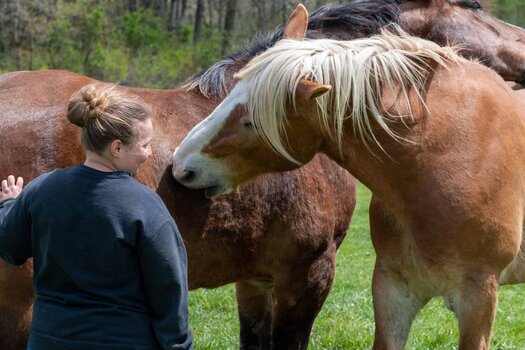
Equine-assisted therapy helps trauma held in the body because horses are deeply attuned to the nervous system. Being present with a large, sensitive animal is a body-first experience — one of regulation, safety, and connection rather than talking. Horses respond to a person’s internal state, offering real-time, felt feedback that helps the nervous system settle.
Horses are prey animals. Their survival depends on reading the emotional and physical state of everything around them, moment to moment. That makes them extraordinarily responsive to what a person is actually feeling underneath — not the words they are saying, but the state of their nervous system.
When a person is anxious, braced, or shut down, a horse notices. And as that person begins to settle — to breathe, to soften, to become present — the horse responds to that too. This creates something that is very hard to create with words alone: honest, immediate, felt feedback about your own inner state, from a being with no agenda and no judgment. It is regulation you can feel, not just talk about.
This is why equine-assisted work can reach places that talking sometimes cannot. It engages the body directly. It happens in relationship. And it invites the nervous system — gently, and at its own pace — to discover that safety and connection are possible. Our equine-assisted approach is guided by clinicians trained specifically in trauma and the nervous system, so that what unfolds with the horses is held within genuine clinical care.
At Take Heart, our work is grounded in a belief that healing is possible and that no one is beyond hope. For those who share it, we hold a quiet faith that people are made for restoration — that we were never meant to carry these burdens alone, and that there is grace for the parts of us that are still bracing for danger. We offer that as an invitation, never an assumption. Whatever you believe, you are welcome here, and the work of healing is honored in the same way for everyone who walks through our gate
If you recognize yourself in any of this — the tension that will not release, the alarm that will not quiet, the sense that you have done the talking and still do not feel at home in your own body — please hear this clearly. Your body is not betraying you. It has been protecting you, faithfully, and it can learn that the danger has passed.
Healing takes time, and it takes the right kind of support. If you would like to learn more about our trauma-informed, equine-assisted approach, we would be glad to talk with you. You can explore our counseling and equine therapy offerings, or reach out to us directly at Info@takeheartcounseling.com or 717-917-7137. There is hope, there is healing, and you do not have to do it alone
We know that visiting a counseling website can feel like a private thing. We use cookies and similar technologies to understand how people find our site and which pages help most, so we can reach more families looking for care. We don't sell your personal information. You can manage your preferences by clicking HERE at any time, and nothing on this site will work differently if you do.